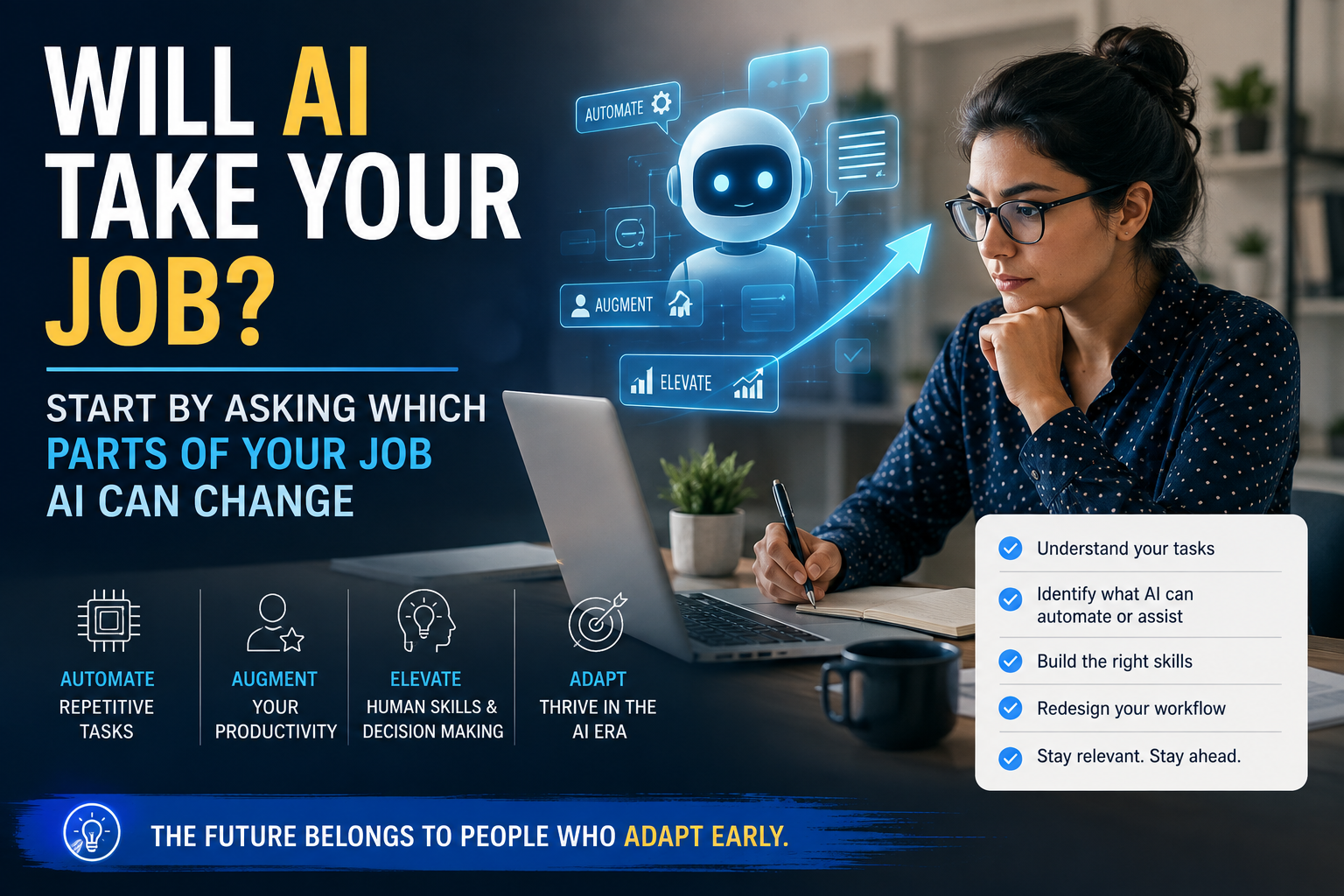
Will AI Take Your Job? Which Parts of Your Work Can AI Change?
Will AI take your job? Artificial intelligence is changing the way we work. Every week, we hear about new AI tools that can write, analyse, summarise, code, design, research and automate tasks that previously required people.
Naturally, one question keeps coming up:
Will AI take your job?
I think that may be the wrong question.
A better question is:
Which parts of my job can AI perform, assist or accelerate — and what should I learn before that changes the way my job is done?
That shift in thinking can make a significant difference to how we prepare for the future.
So, will AI take your job? The more useful question is which parts of your work are likely to change first.
Your job is not one task
Think about your current job.
You probably don’t perform one single activity all day. Your role is a combination of many tasks.
For example, a project manager might spend time:
- Preparing status reports
- Summarizing meetings
- Tracking risks and issues
- Analyzing project data
- Preparing presentations
- Coordinating teams
- Communicating with stakeholders
- Resolving conflicts
- Making decisions
- Managing expectations
AI may be able to perform some of these tasks extremely well.
That doesn’t necessarily mean the project manager’s job disappears.
Instead, the composition of the job may change.
This distinction is becoming increasingly important. The OECD’s 2026 work on AI exposure evaluates how AI capabilities align with the requirements of different occupations rather than simply labeling entire occupations as “safe” or “at risk.” It finds that AI capabilities are currently closer to some routine information-processing and codifiable activities, while contextual judgment, interpersonal understanding, complex decision-making and responsibility remain more challenging areas.
So instead of asking:
“Will AI replace project managers?”
we should ask:
“Which project-management tasks are becoming easier to automate, and which capabilities will become more valuable?”
That is a much more useful question.
Will AI Take Your Job? Four Ways AI Can Change Your Work
AI doesn’t have to eliminate an occupation to have a major impact on it.
I see at least four possibilities.
1. AI automates some tasks
A task that previously required 30 minutes of manual work might eventually require only a few minutes of human review.
If you’re asking, “Will AI Take Your Job?”, the answer depends on which parts of your work AI can automate, assist or accelerate.
Will AI take your job? Not necessarily—but some of the tasks within your job may change significantly.
Examples could include:
- Data entry
- Routine reporting
- Document summarization
- Transcription
- Basic research
- First drafts
- Repetitive analysis
2. AI augments your work
AI may not perform the task for you, but it can make you significantly faster.
For example, a financial analyst might use AI to explore data, while still making the final judgment.
A software engineer might use AI to generate code, while reviewing, testing and designing the solution.
A manager might use AI to analyze information before making a decision.
3. Companies may need fewer people for the same amount of work
This is where the economic impact becomes important.
If AI allows one person to accomplish what previously required two or three people, organizations may eventually change how they structure teams.
The World Economic Forum’s Future of Jobs Report 2025, based on employers surveyed globally, found that 40% of employers expected to reduce their workforce where AI can automate tasks. At the same time, the report projected substantial job creation and emphasized that both technology skills and human capabilities will remain important.
So the future isn’t simply:
AI = fewer jobs
It may instead be:
AI = different work + different skills + different workforce requirements
4. Your responsibilities may change
This may be the most common outcome.
Imagine that AI takes over many of the repetitive activities in your job.
What happens next?
Your employer may expect you to:
- Handle more complex problems
- Make better decisions
- Manage AI-generated outputs
- Work across teams
- Take greater ownership
- Develop deeper domain expertise
- Use AI as part of your normal workflow
Your job title may remain the same.
But your job may no longer be the same job.
The junior employee problem
There is another question we should be asking.
What happens to entry-level work when AI can perform some of the work traditionally given to junior employees?
Historically, many professionals developed their careers by starting with relatively simple tasks and gradually taking on more complex responsibilities. That is why the question “will AI take your job?” is also a question about how people will build their careers.
If AI performs some of those basic tasks, organisations may rethink how they hire and develop junior employees.
The World Economic Forum’s 2026 report on entry-level work found that 68% of surveyed entry-level workers reported increased productivity from AI, while 45% also reported spending more time working as a result of AI.
This doesn’t mean entry-level jobs are disappearing.
But it does suggest that the career ladder itself may change.
That makes early preparation even more important.
Don’t ask “What AI certification should I get?”
This is where I think many professionals are approaching AI incorrectly.
The answer isn’t to collect as many AI certifications as possible.
Instead, start with your job.
Step 1: List your major tasks
Write down everything you regularly do.
Don’t write your job description.
Write your actual work.
Step 2: Classify each task
For every task, ask:
Can AI automate this?
Can AI significantly accelerate this?
Can AI assist me but still require substantial human judgment?
Does this depend heavily on relationships, accountability, leadership or context?
You don’t need a perfect answer.
The purpose is simply to understand where your role may change.
Step 3: Identify your future skill gap
Now ask:
If AI becomes very good at the tasks I perform today, what valuable work will I need to do tomorrow?
This is the most important question in this entire exercise.
Your answer might be:
- I need stronger analytical skills.
- I need to understand AI tools.
- I need automation skills.
- I need stronger communication.
- I need domain expertise.
- I need to learn data.
- I need to understand AI product development.
- I need stronger leadership skills.
Your learning plan should come from this answer.
What should you learn?
There is no universal “AI course” that everyone needs.
Your learning path should depend on your situation.
If AI is starting to automate your routine work
Focus on:
- AI fundamentals
- Generative AI
- Prompting
- AI productivity tools
- Workflow automation
- AI-assisted research and analysis
For beginners, Google’s AI Professional Certificate is designed around practical AI fluency and includes hands-on activities using tools such as Gemini and NotebookLM.
If you’re a business professional or manager
Focus on:
- AI fundamentals
- AI use cases
- Responsible AI
- AI strategy
- AI transformation
- AI-assisted decision-making
Microsoft’s AI Business Professional certification focuses on generative AI fundamentals, prompting and using AI to create and analyse business content.
Microsoft also offers an AI Transformation Leader certification aimed at business decision-makers guiding AI transformation without requiring coding skills.
Google Cloud’s Generative AI Leader certification is another option for professionals who want to understand generative AI fundamentals, business strategy and responsible adoption without needing to become AI engineers.
If you’re in a technical role
Your learning path could be much deeper:
- Python
- Data
- Machine learning
- Generative AI
- LLMs
- APIs
- RAG
- AI agents
- Cloud AI
- MLOps
The important point is not to learn all of these.
Learn what is relevant to the direction your career is moving.
Don’t just learn AI. Learn how to work differently.
This may be the most important advice I can give.
Learning how to ask ChatGPT a better question is useful.
But it is not enough.
The bigger opportunity is learning how to redesign your workflow around AI.
For example:
“I use AI to write my reports.”
Think:
“I redesigned my reporting process so AI collects information, summarizes changes, identifies anomalies and prepares a first draft, while I focus on validation, interpretation and communication.”
The second person isn’t simply an AI user.
They are becoming someone who knows how to redesign work using AI.
That is a much more valuable capability.
Your 90-day AI career preparation plan
You don’t need to completely reinvent your career overnight.
Start small.
Days 1–30: Understand your job
Map your tasks.
Identify which tasks AI can automate, augment or assist.
Start experimenting with AI on real work.
Days 31–60: Build the missing skills
Choose one or two areas based on your skill gap.
Don’t start five courses simultaneously.
Go deep enough to become useful.
Days 61–90: Apply what you’ve learned
Build something practical.
It could be:
- An automated workflow
- An AI-assisted process
- A data-analysis solution
- An AI-powered productivity system
- A small AI project
- A documented improvement to your existing work
Then measure the result.
Did it save time?
Improve quality?
Reduce manual work?
Improve decision-making?
That evidence may ultimately be more valuable than another certificate sitting on your resume.
The future belongs to people who adapt early
Nobody can accurately predict exactly which jobs will exist ten years from now.
And we shouldn’t pretend that we can.
But we can already see that AI is changing tasks, productivity, skills and organisational expectations.
The World Economic Forum estimates that nearly 40% of the skills required on the job could change by 2030, while identifying both technology skills and human capabilities such as creative thinking, resilience, flexibility and agility as important for the future workforce.
That means waiting until your job is visibly threatened may not be the best strategy.
You don’t need to predict the future perfectly.
You need to prepare for multiple possible futures.
So the next time you ask:
“Will AI take your job?”
Will AI take your job? The better approach is to understand what AI can change and prepare before it does.
Stop for a moment.
Ask a better question:
“Which parts of my job can AI change, and what can I start learning today so that I’m ready when they do?”
The goal isn’t to compete against AI.
The question isn’t simply whether AI will take your job, but which parts of your job AI can change.
The goal is to become someone who knows how to work with it — and to keep developing the capabilities that remain valuable as work changes.
Explore more AI & technology articles on Thoughts From Chinna.